
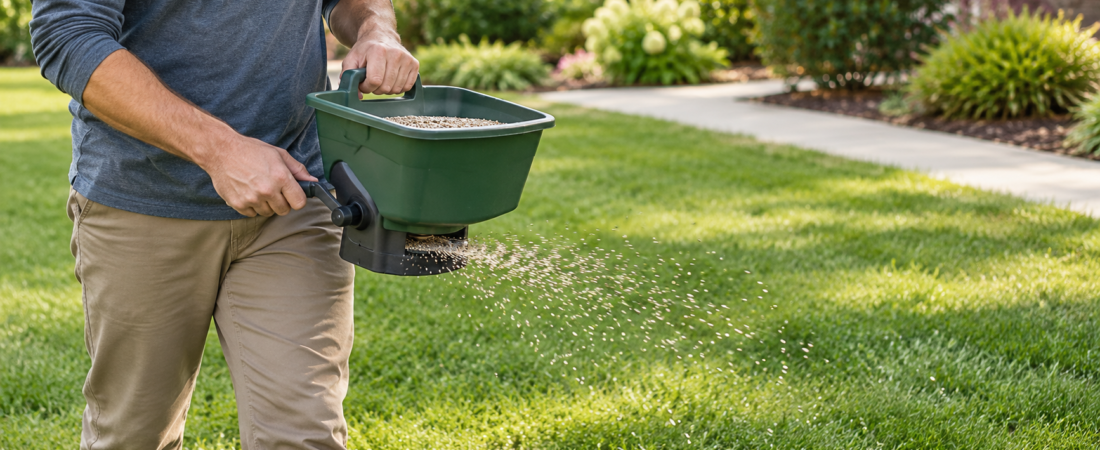
For small lawns, patchy repairs and tight spaces, a good hand spreader beats a push spreader on price, storage and control. It’s the right tool if your lawn is small enough to cover in a few hopper loads without tiring, if it’s broken up by beds and paths, or if you mostly overseed bare spots and touch up edges.
The catch: a cheap one can leave stripes, clumps and burned patches. Pick well and you get even coverage with less product wasted. Here’s what to look for.
The three main types
Most hand spreaders fall into three designs, and the right one depends on how much ground you cover and how precise you need to be.
| Type | How it works | Best for | Watch out for |
|---|---|---|---|
| Hand-crank broadcast | You turn a crank; a spinning plate throws material in an arc | Most small lawns, overseeding, fertilizer | Arm fatigue on bigger jobs; throw can be lopsided |
| Battery-powered broadcast | A motor spins the plate; you hold a trigger | Larger small lawns, people with wrist or shoulder strain | Batteries to charge; slightly heavier |
| Shaker or drop-style cup | Material falls through holes as you shake or tilt | Spot repairs, edges, tiny areas, ice melt on steps | Slow and uneven over open lawn |
If you buy only one, a hand-crank broadcast model covers most jobs. Add a cheap shaker later for spot seeding.
Features that actually matter
Ignore the marketing photos. These six details decide whether a spreader is pleasant to use or ends up in the garage corner.
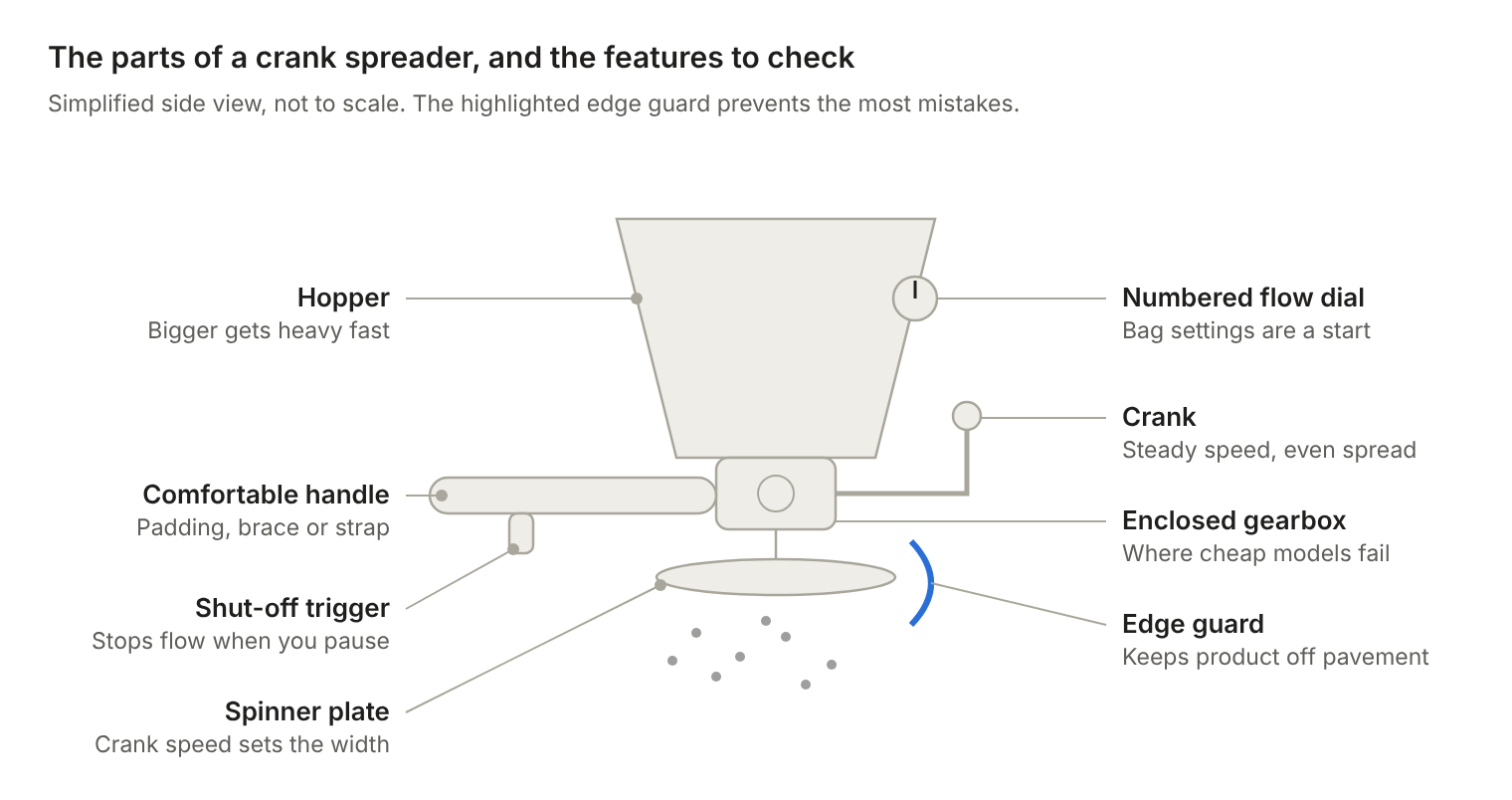
- Adjustable flow settings. Look for a dial with numbered settings, not just open and closed. Fertilizer and seed bags often list a setting for specific spreader brands, so a numbered dial makes those charts usable. Treat them as starting points: your pace, the product and the weather all change the actual output.
- An edge guard or deflector. A small shield that blocks one side of the throw keeps fertilizer off driveways, sidewalks and flower beds. This one feature saves more mistakes than any other.
- Gear quality. The crank gearbox is where cheap spreaders fail. Sealed or enclosed gears resist grit and moisture; exposed plastic gears strip and jam.
- Hopper size. Most hold enough to cover a few thousand square feet. Bigger is not always better: a full hopper gets heavy fast in one hand.
- Comfort. A padded handle, a forearm brace or a shoulder strap shifts weight off your wrist. Try the grip if you can.
- A positive shut-off. A trigger or lever that stops flow instantly prevents piles when you pause or turn.
Match it to what you’ll spread
Think about everything you plan to put through it this year, not just the first bag.
- Grass seed. Light and fine seed needs a low, precise setting. Mixed seed with coating or mulch can bridge in a narrow opening, so check the hopper’s outlet size.
- Granular fertilizer and weed-and-feed. Needs consistent flow above all. Uneven throw here shows up weeks later as yellow or dark green stripes.
- Lime, gypsum and soil amendments. Heavier and often dusty. Pelletized versions spread fine; powdered ones usually clog a hand spreader.
- Ice melt and rock salt. Salt corrodes metal parts and seizes cheap gears. If winter use is part of the plan, choose mostly plastic or stainless parts and rinse it after every use.
If the product bag names a setting for your spreader, use it as a starting point and confirm it with a quick calibration. If it doesn’t, start low and do two passes, which leads to the next point.
Getting even coverage
The best spreader still needs a steady technique. Even coverage comes from three habits: a known rate, a steady pace and overlapping passes.
- Calibrate once. Mark off a 10 × 10 ft square (100 sq ft). Weigh a small amount of product, spread it over the square at your normal pace, then weigh what’s left. Bag rates are usually per 1,000 sq ft, so your square should use one-tenth of that rate. Used more? Dial down. Used less? Dial up.
- Keep a steady rhythm. For crank models, use the cranking speed in the manual if it gives one, pick a walking pace you can hold, and keep both the same the whole way, including when you calibrate. Speeding up throws wider; slowing down drops more near your feet.
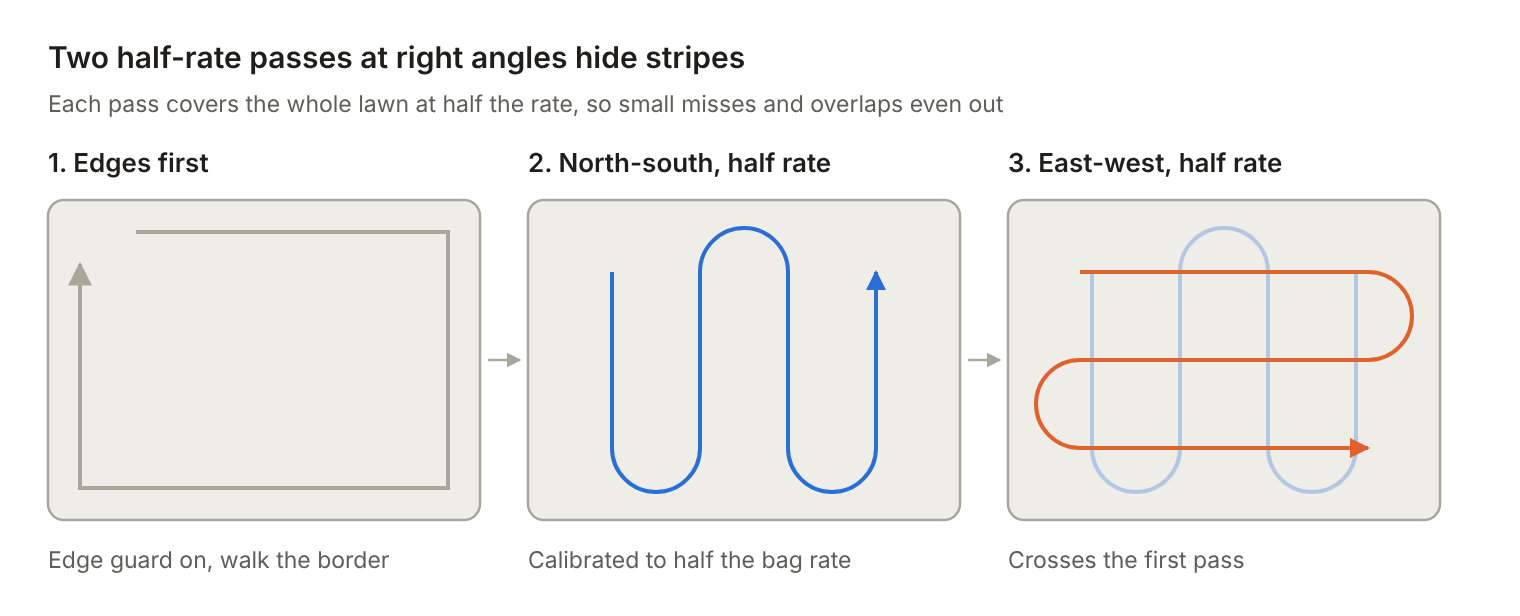
- Do the edges first. Walk the perimeter with the edge guard on, then fill in the middle.
- Do a half-rate cross pattern. Use your calibration square to find the setting that puts down half the bag’s rate. Don’t just halve the dial number: dial numbers rarely scale evenly with output. Walk the lawn north-south, then again east-west. Small errors cancel out instead of making stripes.
- Fill over a hard surface or tarp. Spills on grass leave a burned or overseeded patch. Sweep any granules off pavement back onto the lawn.
Care, cleaning and storage
A well-kept hand spreader lasts many seasons; a neglected one seizes by next spring.
- Empty it after every job. Fertilizer absorbs moisture and cakes in the hopper. Pour leftovers back into the bag.
- Rinse and dry. Hose it off, especially after fertilizer or salt, then let it dry fully before storing.
- Spin it while drying. A few cranks after rinsing clears water and grit from the gears.
- Store it dry and out of the sun. UV makes plastic brittle. A hook in the garage or shed is ideal.
- Check the settings dial each spring. Make sure it still opens and closes fully before you trust the numbers.
Quick buying checklist
Take this to the store or keep it open while you shop online.
- ☐ Lawn is small or broken up enough that a hand spreader makes sense
- ☐ Type matches the job: crank, battery or shaker
- ☐ Numbered flow dial, not just open and closed
- ☐ Edge guard or deflector
- ☐ Enclosed or sealed gears
- ☐ Comfortable handle, brace or strap
- ☐ Instant shut-off trigger
- ☐ Corrosion-resistant parts if you’ll spread salt
A hand spreader is a small purchase, but it decides whether your fertilizer and seed land where they should. Choose one with good gears, a real settings dial and an edge guard, calibrate it once, and your lawn will show the difference.